Thursday, June 12, 2008

Plum Hanami, Bird and Flower Park, Golden Week

It’s been a long time between posts, so it’s high time we filled you in with some pictures of what we’ve been up to.

(Click image to see Aboshi plum festival)

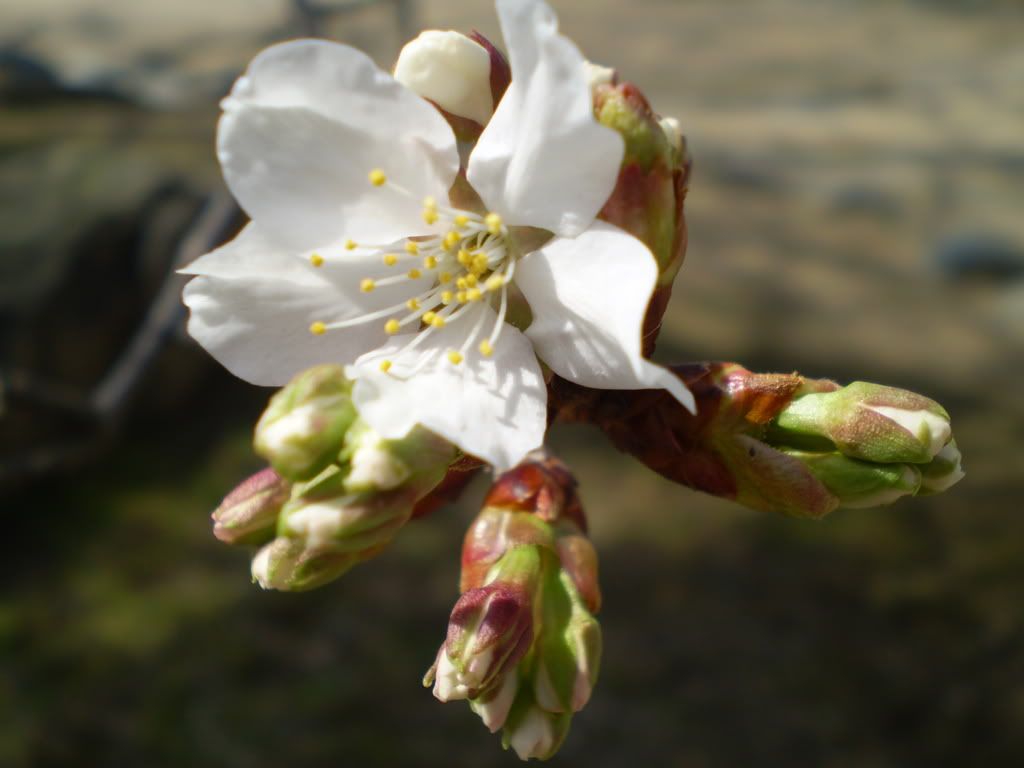
The first blog-worthy event that has yet to find its way into a post was a lovely pre-spring outing spent among the plum blossoms in Abeyama plum grove park, which is south or Himeji city and sits high on a hill overlooking the Seto Inland Sea. The preceding night Matt and I had our fun-loving group of JET pals over for a delicious nabe dinner and obligatory karaoke session. A little worse for wear, we set out in the morning for a nutritious Mister Donuts breakfast and took off on the hour and a half train and bus journey with bento boxes in hand. Unfortunately, as the day was warm and nearly cloudless we were joined by a large number of plum blossom viewers, which in itself is not a problem, but when a large number of these people are squished onto a slow moving bus which is still running winter heating, well let’s just say it’s a tad uncomfortable. Nonetheless, we survived and had a delightful afternoon under the plum blossoms over looking the sea.

(Click the image to see more bird and flower action)

The second blog worthy event happened during my parents’ visit to Japan. After enjoying a tour of a sake making factory we headed off to Port Island’s Bird and Flower Park. The advertisement for this place showed a pretty spectacular flower display, so spectacular we thought it was photoshopped. However, upon arriving we discovered there was no need to photoshop as teams of fuschias in full bloom hung from the ceiling, giant water lilies lay on the ponds and cancans soared freely around us in their spacious enclosures. I felt like I was on the set of the original Willy Wonka film or in the technicolour land of Oz.

(Click to see more Golden Week photos)

The third blog worthy event was huge and simply can’t go without a mention. I speak of Golden Week, so named because there is a succession of Japanese public holidays, and companies often give their employees the entire week off. My Golden Week(end) was spent with the Golden Girls (the young ones in Japan, not the old cronies living in Florida). We all trooped into Osaka and met up with Aimee in Shinsaibashi the huge shopping mall. Unusually, we were not there for shopping; more girly things awaited us, namely, food, chat and massages. I am sure I don’t boast when I say I am as good as a professional at eating and chatting; however, this was my first encounter with a professional masseuse and it was gooooooood! After a lot of girly talk and a little sleep, we headed into Nara the next day. Here we encountered a rather international Colonel Sanders, plenty of deer and a whooping great big budda. Not to mention my favourite—festival food. Then, after even less sleep than the night before, we met with the boys to do some more eating and singing. This year’s Golden Week got full marks on the funness metre.

Monday, May 19, 2008

Wakayama

A few weeks ago Matt, I and two teachers from my school went on a journey that took us south of Osaka’s seemingly endless urban sprawl. We went to Wakayama. This trip was meticulously planned by my go between at Maiko high school, who also doubled as our expert driver for the trip. Waking with the birds we left Kobe city at 6.00 am, cheated our way through Osaka’s crowded streets by taking the elevated expressway and arrived in Wakayama prefecture by 8.00 am. Here we strolled around the grounds of Wakayama castle, confirmed that Mos Burger doesn’t have a breakfast menu and had MacDonald’s for the first time in Japan.

(Click images to view slideshows)

Wakayama Castle

For the rest of the day we travelled along Wakayama’s coast making brief stops at some interesting and beautiful places. First, Tore Tore Ichiban is a fish market well known by locals for its delicious fresh fish. Here you can watch giant tuna being diced, pick your shell fish fresh from the tank and even pick up some whale meat, however, ask for a fish head to use as a table decoration and you will flatly be rejected.


Tore Tore Ichiba

Second, Engetsu rock which gets its name from the circular shape at its centre (en meaning circle and getsu meaning moon). Third, Senjojiki beach which gets its name because its wide open space seems to have room for a thousand tatami mats. Fourth, Sandanbeki cliff that bears some resemblance to southern Western Australia’s coastline. Finally, Kushimoto, the most southern part of the mainland Honshu island. Here we encountered a choral group singing traditional Japanese songs and many more unusual rock formations.


Engetsu


Senjojiki


Sandanbeki


Kushimoto

At the end of our long day we made our way to a Japanese style hotel called Arafune. Despite its less than impressive façade, the interior was newly refurbished. To Matt’s great delight not only did the hotel have hot spring baths and pool table facilities, each room came replete with Western style toilets!


Arafune Ryokan


However, the most interesting aspect of the hotel was the food. Upon sitting at the dinner table, we were served what can unequivocally be classed as the freshest of fish—shrimp and muscles to be precise. A tiny BBQ sat in the middle of our table, its flames licking at the open grill. What happened next could easily have been lifted from one of Peter Singer’s nightmares, for as the shrimp and muscles were placed on the BBQ they started moving! Indeed, they were still alive and trying to break free from their now searing hot shells. This intolerable cruelty lasted for about minute at about which time they settled into their endless sleep. Such an experience is almost enough to make one vegan.


Zankokuyaki

The next day we returned to Kobe via mountain passes. First we stopped at Mt Nachi and walked up an ancient pilgrims path (some people hired costumes so they could walk it in traditional kimono) to the temple which also commanded an view of Mt Nachi’s magnificent waterfall.


Climbing Mt Nachi


Mt Nachi


Mt Koya

After stopping for lunch we went through the mountains--this was the adventure part of the weekend! The road around the mountain was littered with many large fallen rocks and was only wide enough for one car despite being for 2 way traffic. Also, it was incredibly windy: the only way to check if there was a car approaching in the opposite direction was by looking in the misty mirrors. This was all good while the sun was still up, but as it began to set my go-between became anxious to get out of the mountain area and went into speed racer mode. As we careered in straight lines around sharp corners I quietly recalled all the special moments in my life and thought of all the people who had touched my life, while clutching desperately to the handrail to control my nerves. Luckily we did not need to rely on the slight metal rail to protect us from the almighty fall down the mountainside as we made it home safe and sound.

Saturday, May 10, 2008

Highlight from Week 3: Hiroshima

Apologies to Kobe, but Hiroshima has to be my favourite Japanese city thus far. The last time we visited was via six long, slow hours of JR rail in the middle of winter. This time, in the first days of the cherry-blossom season, we travelled in speed and style aboard the Shinkansen, and therefore still had the whole day to sight-see.

Shukkeien Garden
(Click for slideshow)

Much of our sight-seeing was done on foot. We crossed the Kyobashi-gawa river west of the JR station, and made our way to Shukkeien Garden. Originally built for the local warlord in the 17th century, the Garden was destroyed in the 1945 bombing, after which it was rebuilt. Teachers have told me that Shukkeien isn’t the best Japanese garden in the country, but we thought it was pretty spectacular.

Hiroshima Castle
(Click for slideshow)

After lunch under a grove of cherry-blossoms, we walked further west to Hiroshima Castle. Like Shukkeien, and much else in Hiroshima, this 16th-century building also fell victim to the bomb, and what stands in its place is a 1958 reconstruction. The foundations of pre-1945 buildings can still be seen, and the tower itself houses a museum and observation deck giving a decent view of the city. In the outer bailey there was a food stand where we introduced Emma’s parents to takoyaki, and beside the moat stood an Australian eucalypt which had survived the bombing.

Peace Park and Memorial Museum
(Click for slideshow)

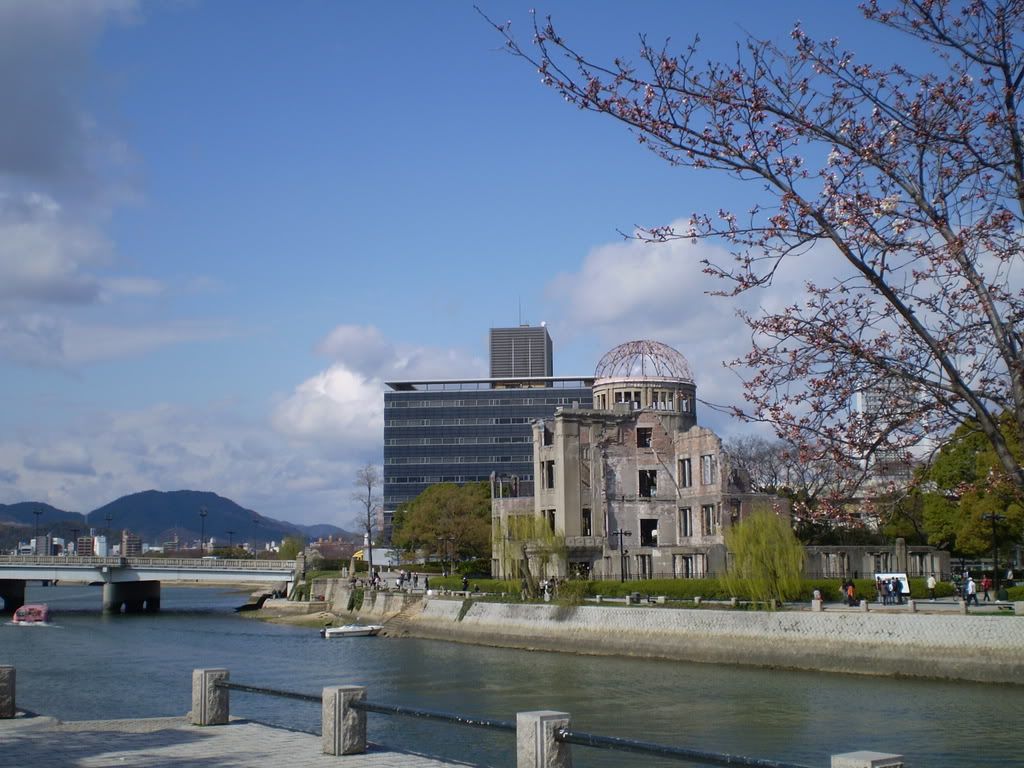
From the Castle we walked south to Peace Park. The first image to greet us was the A-bomb Dome itself, silhouetted against the cloudy sky. The Dome stands at the northern end of what is a spacious and magnificent urban park—the “Kings Park” of Hiroshima, if you will. At the southern end is the Peace Memorial Museum, which provides a harrowing guided tour of the events and aftermath of August 6, 1945 (though it provides too little detail of the reasons for Japan’s involvement in the war, in my view). We came here in January, but were pressed for time, so it was good to be able to give the exhibition a more thorough viewing.

Our flashy hotel, the Grand Prince (no slideshow)

We ate dinner at Okonomi-mura, which is a complex of okonomiyaki stalls housed on two floors of a building in the Shintenchi district, then caught a tram from the station to our hotel down by the harbour. In defiance of hotel policy we smuggled in conbini food for breakfast, rather than taking out a mortgage for the privilege of eating in the hotel dining room. The next morning we took a ferry from the hotel to Miyajima.

Miyajima (Click for slideshow)


I was glad to return to Miyajima, because on our last visit we arrived later in the day, and I wasn’t able to climb the 500m+ Mt. Misen. This time I hiked up the northern face, while Emma took her parents to the summit in the cable car. I don’t think the photos really tell the story, but the view from up there is spectacular. Once again we encountered the friendly local inhabitants—the monkeys and deer—though the latter were a little too friendly, sadly, for Emma and her dad.

Mt Misen
(Click for slideshow)

Sunday, May 4, 2008

Hanami


This is going to sound awfully clichéd, but have you ever been somewhere and felt as if you’ve stepped into a fairytale?

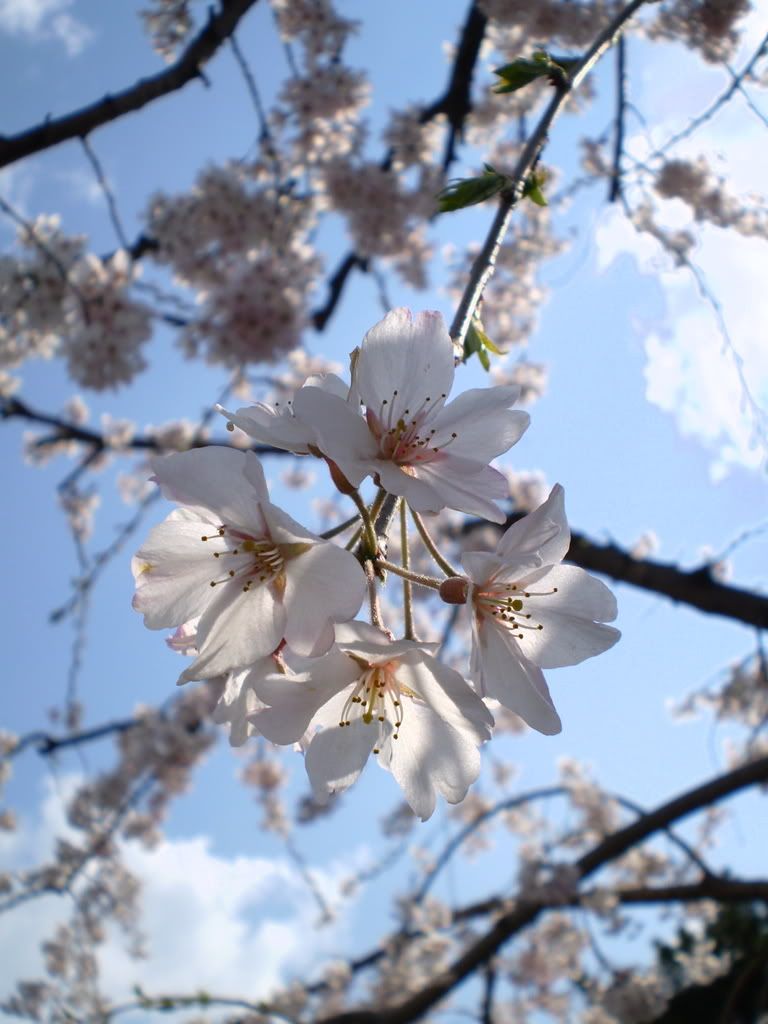
Japan’s brush with sakura is fleeting. It has to be. To paraphrase Robert Frost, nothing this impossibly, wonderfully pink can stay.

Through summer and autumn you don’t even notice them. They’re just trees like any other trees. And, like any other trees, they strip themselves bare of their leaves in the winter. Just ordinary trees.

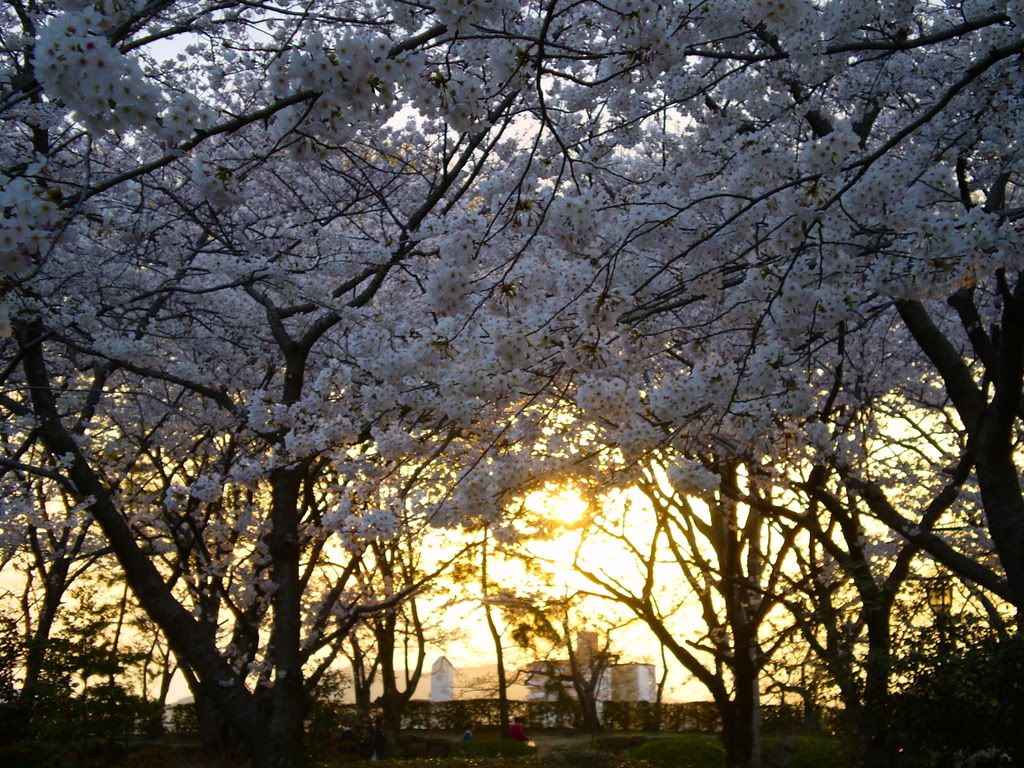
And then . . . a single petal. A single blossom, half-glimpsed, perched on the end of a twig. The tourists queue to capture the memory on film. Within a week, the cherry blossoms have spread, like a rumour, to the four corners of Kansai. Standing ancient, majestic and alone at Kyoto’s Yasaka Shrine. Bending their sad limbs over the waters on the Philosopher’s Walk. Raising their black arms into a canopy of pink and white in the Peony Garden at Himeji Castle.

And beneath the canopy, and beneath the evening blue sky that can be glimpsed between the petals, a carpet of blue tarpaulin, upon which the locals gather to look at the flowers, and sing karaoke (badly), with their eskies full of beer and sake, and steak sizzling on their barbecues. The Japanese have never looked more Australian.

This, my friends, is why God invented the digital camera! Click the images below for slideshows . . .

The beginning: Kikumasamune Sake Brewery, Nada-ku


Tenryuji Temple, Arashiyama


Heian Shrine, Kyoto


The Philosopher's Walk, Higashiyama


Yasaka Shrine, Gion


Evening at Himeji Castle


Osaka Castle


The last of the cherry blossoms: Sumaura

Thursday, April 17, 2008

Lightning doesn't strike twice, but it appears earthquakes do

Yesterday morning, at about 1am, a small earthquake struck Osaka Bay. It woke us both up; but Emma couldn't recollect it happening the next morning, so I put it down to a vivid dream until I asked some teachers about it later in the day.

It happened again just after 4am this morning. Only very minor--we're both intact, and more importantly, our bottle of Lambrusco is still sitting happily on top of the buffet. To put things into perspective, around 20 percent of the world's earthquakes happen in Japan. I couldn't find any information online regarding yesterday's local earthquake, but it appears a larger one also struck north of Tokyo. I guess we should be surprised, then, that we hadn't encountered a tremor sooner.

Sunday, April 13, 2008

Highlight from Week 1: Kinosaki

On the Bantan line

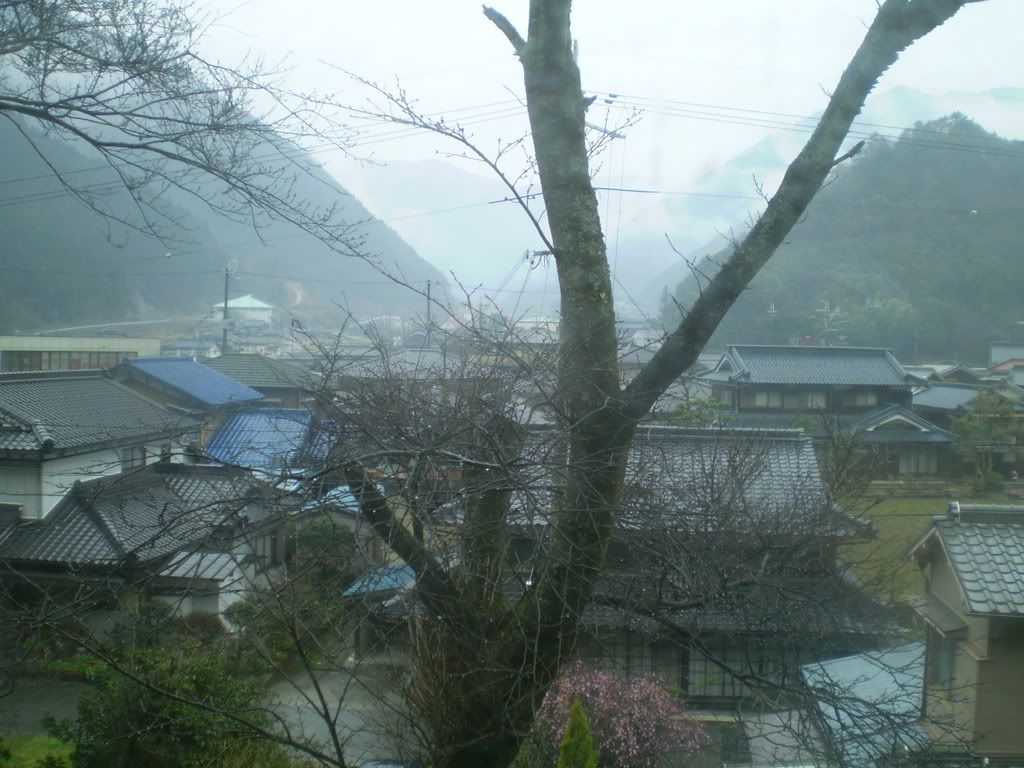
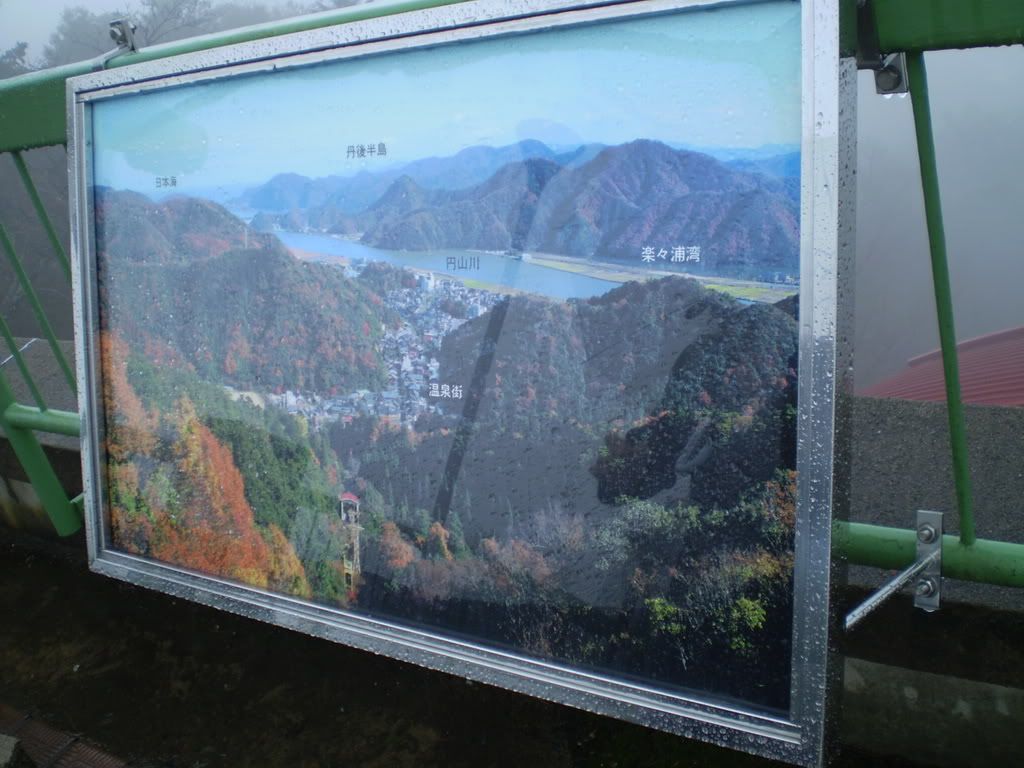
This day afforded us a rare glimpse of the “backwoods” of Japan (i.e. fewer skyscraping tenements per square kilometre), as we journeyed on a slow and rickety train from Himeji across central and northern Hyogo. Our destination was the resort town of Kinosaki, which is famous for its many onsen, though unfortunately, given the miserable weather, we didn’t get a chance to visit any of them. Instead, we took a ropeway up Mt Onsenji, stopping along the way to look around Onsenji temple.

The view of Kinosaki and the surrounding area from the summit of Onsenji is said to be breathtaking: on a clear day you can see the Sea of Japan.
This was not a clear day. (Click the image above to see a slideshow of Kinosaki and Onsenji.)

But even in bad weather, Kinosaki is a picturesque little village: very European-looking (though I really have no basis for comparison), and Emma and I hope to return soon. We made the most of things by soaking our feet in a small hot-spring by the side of the main street, with the intention of visiting a few onsen after booking into our hotel, but that didn’t eventuate. The hotel in question, a ryokan, turned out to be a fair distance away from Kinosaki, and the constant rain (it never pours, but it rains in Japan) stranded us there. And so began our first experience of traditional Japanese accommodation.

(Click the image above to see a slideshow of the ryokan)

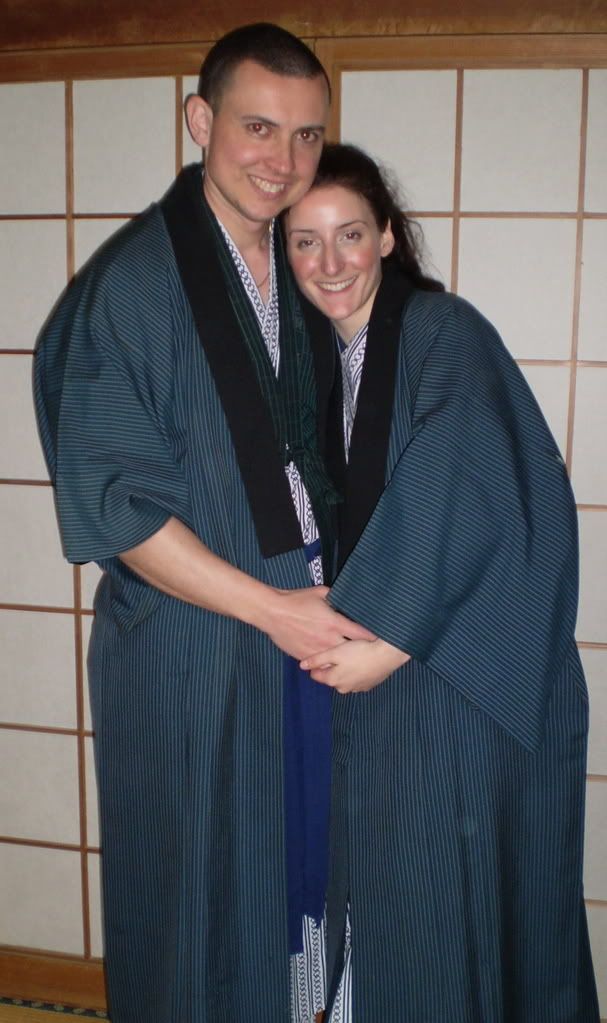
It would be putting things mildly to describe the ryokan as austere. From the outside it looked like the kind of establishment that in a Western country would normally play host to marital infidelity and drug deals. We were greeted in the lobby by a friendly old lady who spoke no English, but with the aid of Emma’s Japanese was able to show us upstairs to our rooms. These consisted of a tatami room for sleeping, a small anteroom for removing your shoes, and another anteroom by the window containing a washbasin, a mirror, and an inoperative fluorescent lamp. The youngest item in the room was Emma. At the end of the hall were the toilets, all of which were squats (but more on that later). The old lady returned with tea and informed us that dinner would be served at 7pm, so we changed into our yukata, had a few photos taken with Mum, and then headed downstairs.

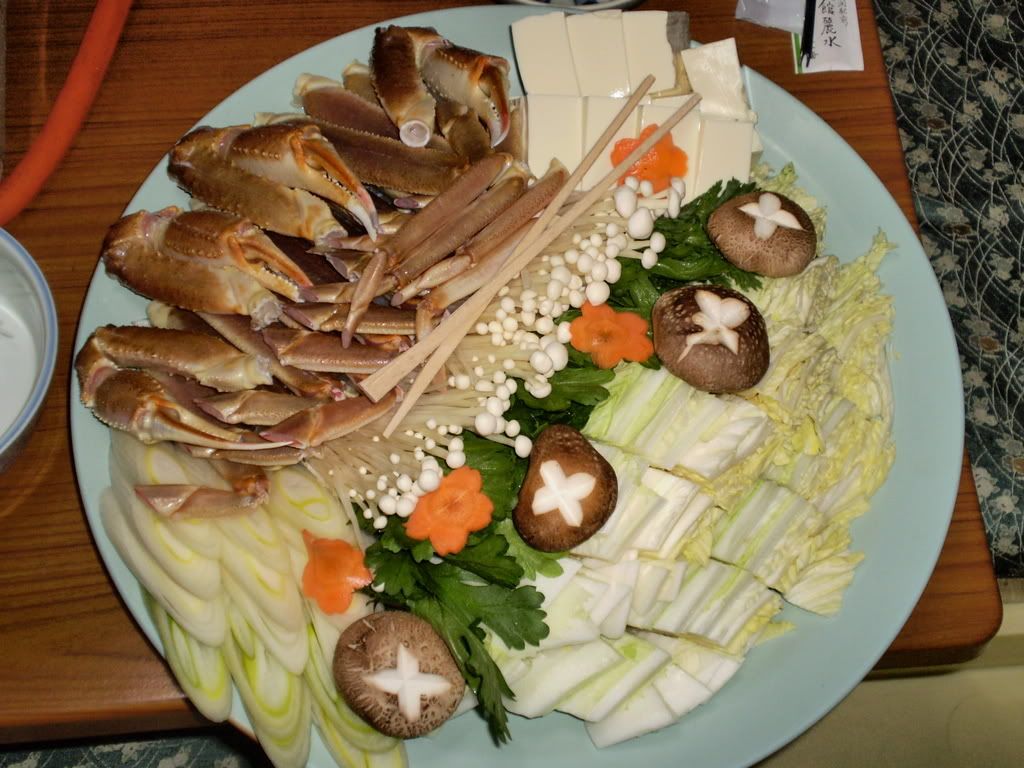
We were expecting to eat in the dining room, but our host showed us instead to a smaller room off an adjacent corridor. There we found, to our delight, a mountain of noodles, rice and vegetables, and a nabe pot bubbling away.

Better still, since this part of Hyogo is crab country, there was crabmeat on the plate in quantities for which you’d have to mortgage your house in Perth. We ordered 3 beers, and our host returned with longnecks, at no extra charge! Though Dad found the concept of cooking for yourself in a hotel confusing, the ryokan all of a sudden did not seem as overpriced as it first appeared.

Copious amounts of beer and a very full stomach forced me to confront an aspect of the Japanese lifestyle I had somehow hitherto managed to avoid, though I knew someday it would catch up with me. Yes, I was obliged to use a squat toilet. I’ll say two things about using the squat toilet, and leave it at that. (1) The squatting position definitely makes for a very fast and efficient method of “purifying oneself,” so to speak, which may explain why the Japanese haven’t yet abandoned it. (2) The Japanese believe that the squat toilet is more hygienic than the Western toilet, since you don’t make any contact with the seat. This sounds like a good theory, but it actually takes a great deal of logistics and forward planning to make it work. Your pants and underwear are bunched around your ankles, and you want to avoid having these touch the rim of the toilet. On the other hand, squatting puts a lot of pressure on the bladder, meaning that number twos are usually accompanied by number ones, and you definitely don’t want your underwear getting in the way of the stream. Your spare third and fourth arms, the ones you keep packed away for just such an occasion—these you use to balance yourself against the walls. Since I was only wearing a yukata at the time, and since the cubicle had high doors, I ended up stripping naked. And that’s probably more information than you need.

The second best feature of our ryokan experience—the crab nabe was definitely the best—was the fact that it contained a hot spring. Nothing too fancy—no sauna or iron bath or anything like that—just a simmering hot bath that stayed hot. Like being boiled alive—the nice way. I had the place to myself, too: there were very few other guests in the ryokan, and Dad wasn’t game enough to try it, though Mum joined Emma in the women’s onsen.

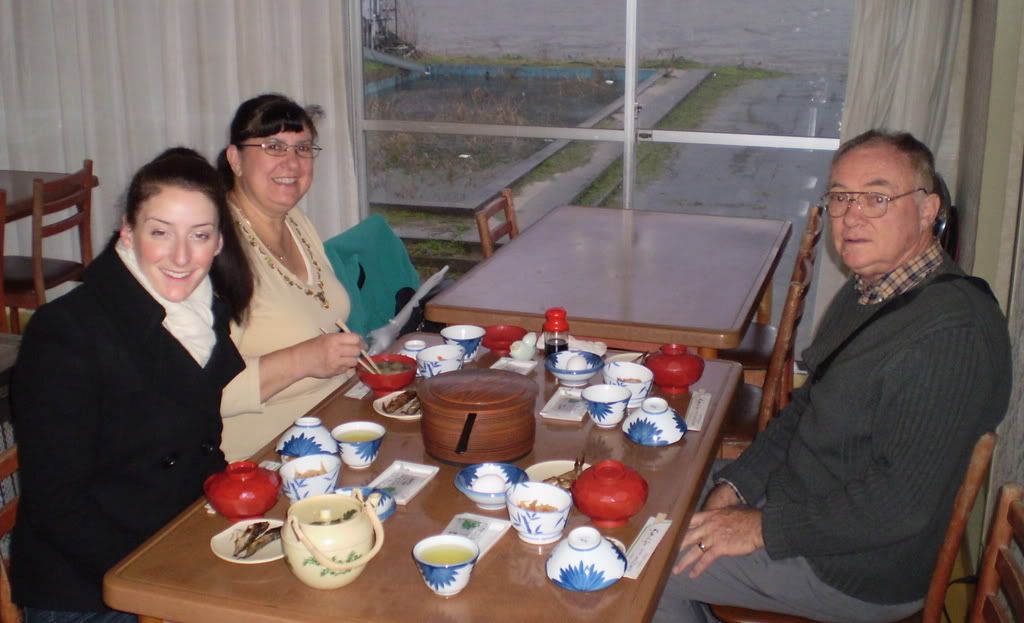
The next morning we were called to breakfast in the dining room at around 7am. I wasn’t expecting crumpets and Weet Bix, but nor was I expecting a whole dried fish to greet me as I sat down to eat.

And you know what? I ate it—well, everything except the head. (It was delicious.) The raw egg, on the other hand, was a bridge too far even for me; Mum found a use for it in the miso soup. We had planned that day to stop in Amanohashidate on our way home, but it was still raining and we decided it wasn’t worth it. Emma, making small talk, said as much to the host, who replied with “Ame no hashidate!” Even the Japanese can make Dad jokes.

We're back!

Usually when we take this long to update our blog it’s because we’re bone lazy, or are busy with more pressing matters, but this time we have a good excuse. We’ve been on holiday for the last 3 weeks, and have spent most of that time traipsing across western Japan with our parents in tow. We won’t blog every last detail—that’s just not our style—but we do want to tell you about the highlights. So stay tuned . . .