Showing posts with label JET. Show all posts

Friday, December 7, 2007

Tokyo Disney Sea

(Preface: You'll find that if you double-click most of the photos in this post, you'll be taken to a slideshow)

Day one in Tokyo: Matt hearts beer

Tokyo Disney Sea is cool! All my reservations, that a visit to the Disney franchise as an adult would mar precious childhood memories of delightful days spent exploring the original theme park in Los Angeles with my brother and parents, were immediately dissipated upon our entry. Once inside, we met with a shiny blue and gold globe that was dancing on water, and from that point on we were dancing on wonderment and pure childish enjoyment.

Mediterranean Harbour & American Waterfront

The whole attraction is called Tokyo Disney Resort and is made up of two theme parks, Tokyo Disney Sea (for adults) and Tokyo Disney Land (for kids), which are connected by a monorail that sports very cute Mickey silloutte shaped windows. However, separate tickets are needed for entry into each park, and we only had one day to play with, so we opted for TDS as some of the other ALTs we went with had already been to TDL.

Mysterious Island


Mermaid Lagoon


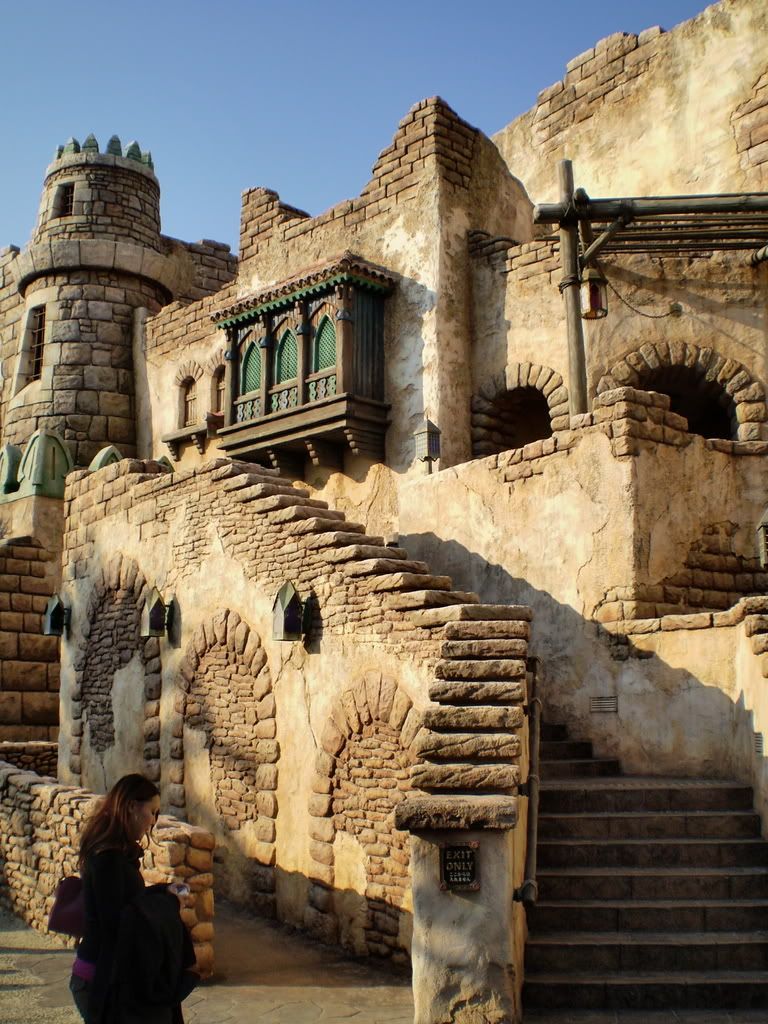
Arabian Coast

While the place just screams rampant commercialism, and everything is shiny and perfectly painted, it was incredibly easy to forget any niggling bleeding-heart/critical-thinking instincts and get caught up in the spectacle and excitement. The best bits were the Indiana Jones ride (in the "Lost River Delta" section of the park--click the image to the left to see the slideshow--where we had to wait 100 minutes in line), Journey to the Centre of the Earth ride (luckily we got a fast pass to this one earlier in the day and it only a 10 min wait), Raging Spirits roller coaster with its 360 degree turn, the Little Mermaid live show (which involved puppetry and a lot of suspended rhythmic gymnastics) and Aladdin’s Magic Lamp Theatre. Thankfully this last show came with a DS Nintendo style translator to allow us to understand the story, as well as allowing us to sport some obviously couture 3D glasses which brought the genie's magic to multi-dimensional life, not to mention the automated seats that gave us a surprising kick up the butt.
As you can tell, we had a fantastic long weekend, and we really appreciate Shibata-sensei's help in organising the trip. Matt's last day could have been better: evidently something he ate at Mister Donuts on Sunday morning--probably the frankfurt-in-pastry thing the clerk neglected to heat up--strenuously disagreed with him. Fortunately he made it home still bearing the contents of his stomach, but he tells me that it was touch-and-go on the flight from Tokyo to Osaka, where he was seated next to an old man who possessed a very vocal digestive system and whose red wine and beer nuts were repeating on him at the most inopportune of times. Still, it wasn't all bad news . . .
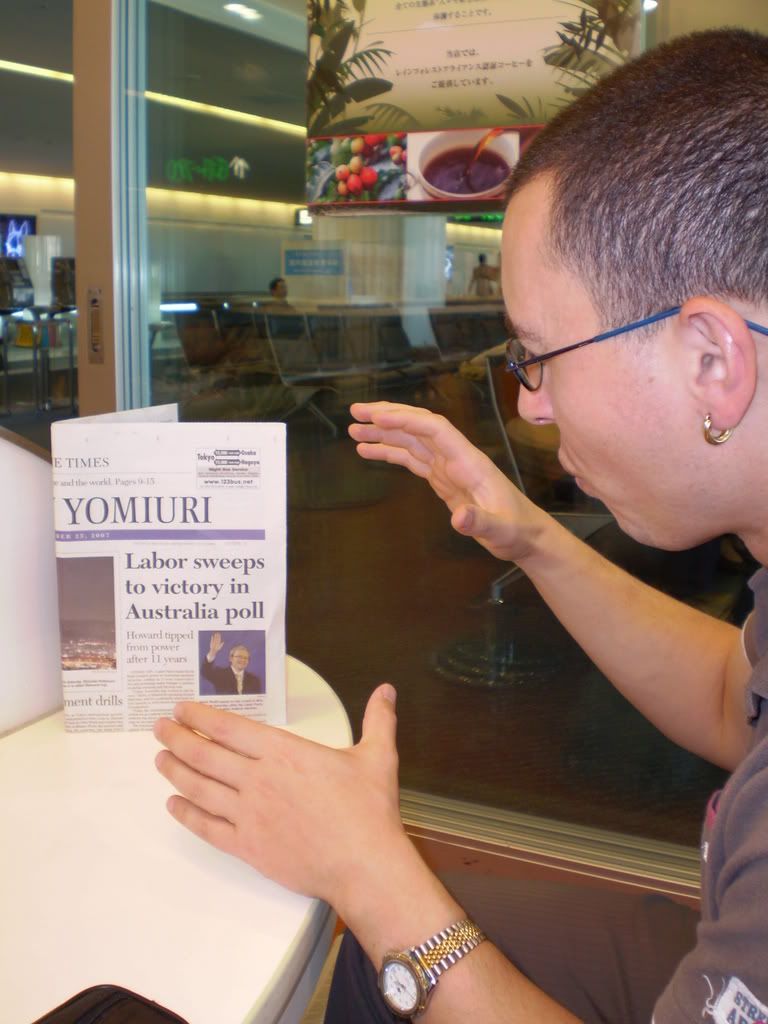
Matt hearts the election result


Thursday, December 6, 2007

Mt. Shosha, Himeji

About a week or two following our trip to Kyoto, we returned to Himeji. The occasion? An all-you-can-eat Thanksgiving dinner: ostensibly for American ALTs, though we managed to get ourselves invited anyway. Given that we had a day to kill, a few of us--namely Dan K, Goran, Amanda, Emma and myself--decided to meet at the JR station early(ish) in the morning and hike up Mt. Shosha.

(As with the previous post, click the images to see slideshows.)

Though I doubt it's a tidbit of information I'll be proud to relate to my grandkids in years to come, Mt. Shosha is famous for being one of the locations of the Tom Cruise vehicle The Last Samurai (which was mainly filmed in New Zealand). At its summit lies Engyo-ji Temple, which in my view ranks alongside some of the temples of we saw in Kyoto in terms of its beauty, and has the added benefit of being situated at a reliable distance from downtown Himeji. It took us a little while--not to mention the aid of the bilingual Dan and a helpful local--to find the path leading up the mountain, and on the whole I'd have to declare it a little more difficult than Sumaura. (But no less enjoyable.) Fortunately, Emma and I are obliged to scale a mountain to get to our bus stop each day, so we were more than capable of handling this little hillock.


At the top of the mountain, and at the door of the Engyo-ji complex, we took advantage of a lookout. Himeji looks amazing from this vantage point, flanked by rolling green mountains, and with outlying hills rising like islands from the surrounding metropolis. This is the kind of view that makes hiking up a mountain--as opposed to taking the ropeway--all the more worthwhile. You feel as if you've earned it, somehow.


Engyo-ji itself is a massive complex, and the temple proper is a fair distance from the gates, but at this time of year (autumn) the hike is a reward in itself. The path leading from the gates to the temple buildings is lined with buddhas, and close to the gate there is a large temple bell which visitors are welcome to toll. (It is supposed to bring good luck.)The buildings themselves are impressive. Depending on which route you take from the gate, the massive main building appears before you very suddenly, over the crest of a hill. Behind the main temple are the lecture theatres, arranged around a wide courtyard. It was here, evidently, that the scenes from The Last Samurai were shot. (I was inspired thus to regale my fellow travellers with the curious beliefs of the Scientologists, which are summarised here.)
But IMHO the main attraction of Engyo-ji is the flora--chiefly the red momiji (maple), and I'm afraid that our photography can't really do justice to the combination of bright greens and yellows, and brilliant, sharp reds, that we saw there that day. (Even after Emma's great editing work.)
It's one of those things that you have to see for yourself.

Let's see . . . what else did we do that day? Well, after hiking back down the mountain (precariously), we made our way to an onsen (hot spring) in the CBD. Neither Emma and I had been to one before, and I was a little concerned that I would be denied entry because of my tattoo, but nobody seemed to mind. Goran and Dan showed me the ropes: the art of a good onsen, as I understand it, is to subject your body to extremes of heat and cold, and repeat this process until you're ready to be flayed alive and eaten. (That's if the sauna doesn't cook you first.) Then you take a dip in the hot spring briefly before fleeing the hungry locals.

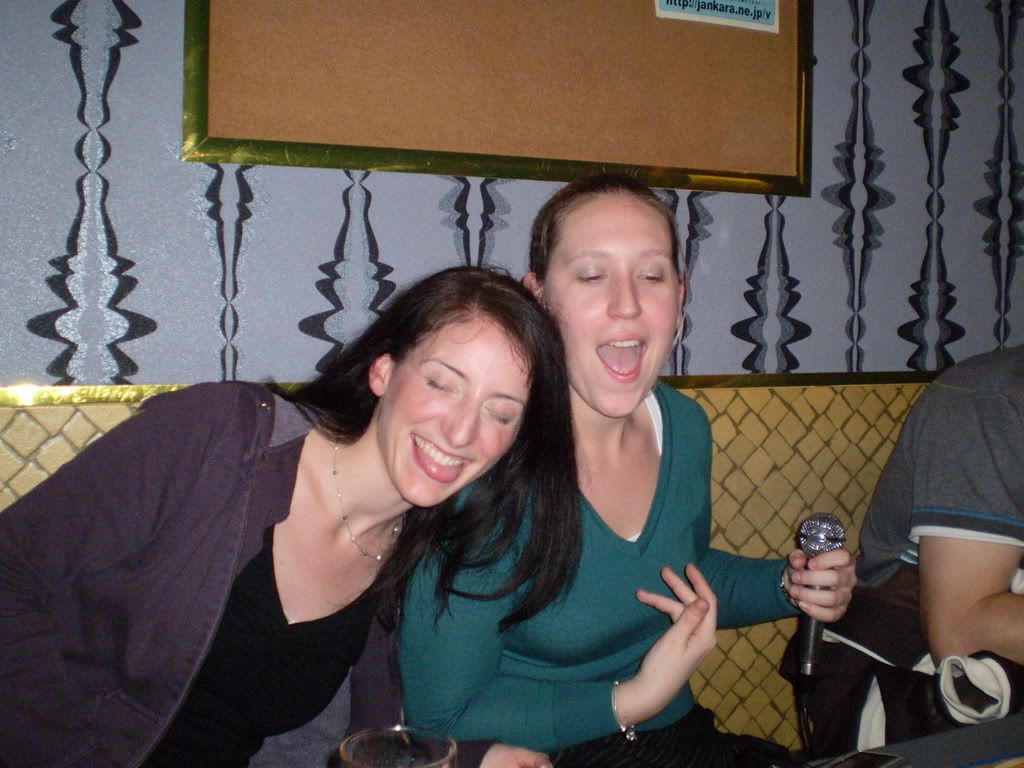
At the Thanksgiving the Australian table (with two Americans along for the ride) was the life of the party, naturally. Although the party was held at a restaurant the food was homestyle--though in a good way (go to Miss Mauds in Perth if you want to try it the bad way): mashed potatoes, chilli con carne, stuffing (mmm . . . stuffing) and turkey (of course). Dan and myself did ample justice to the all-you-can-eat terms of reference, downing six plates between us. Afterwards a group of us finished the evening at a karaoke bar--it is the law here, after all--in a raucous session truncated (to half an hour) by the fact that we all had trains to catch.

Tuesday, November 13, 2007

Matt and Emma's (Very Brief) Guide to the Federal Election (Senate)

Emma and I have recently received our postal vote forms, and we've been discussing who we will vote for (and in what order of preference). For those JETs who are reading this, the Australian Embassy in Japan website has information on overseas voting, but you basically have a choice of either pre-poll voting at your nearest Australian consulate, voting at the Embassy or at a selection of consulates on polling day, or postal voting (a form for which is available here).

If you want detailed information on how to vote, your best bet is to consult the relevant pages at the Australian Electoral Commission website:
How to vote for a Member of the House of Representatives
How to vote for a Member of the Senate
But the long and short of it is that at the polling booth (or in the mail, if you're postal-voting), you'll receive a green House of Representatives ballot paper and a white Senate ballot paper. While on the House of Reps paper you must mark all of the boxes in order of preference, the Senate ballot paper is slightly more complicated. There you have the option of either marking all of the boxes below the big black line in order of preference, or placing a "1" in the box next to the party you want to vote for above the line (leaving all other boxes unmarked).

Now, remember: Australia has a preferential voting system, and this includes voting for Members of the Senate. Each party (actually each "group" on the Senate ballot paper: candidates for a particular political party are grouped together, but so also are some independents) lodges with the AEC a full ticket of preferences to all candidates who appear on the ballot paper. It's called a group ticket. Why is this important? Because if you vote above the line, you're consenting to having your preferences allocated according to the group ticket. Apparently more than 95% of voters use this option--this is why you hear of various parties doing "preference deals" and so forth--and I'm betting that relatively few of these are aware of its implications. If you're thinking of voting above the line, I suggest you take a bit of time to look at your state's group voting tickets first.

Anyway, here are the websites of the parties (and independents) that appear on this year's Senate ballot paper:
Nationals
Citizen's Electoral Council
Christian Democratic Party
Non-Custodial Parents Party (Equal Parenting)
Democratic Labor Party
Liberal
Australian Democrats
One Nation WA
Family First
Senator On-Line
Carers Alliance
Australian Labor Party
Eric Wynne (Christian Independent)
Kevin Fitzgerald (Independent)
Climate Change Coalition
Socialist Alliance
Jennifer Armstrong (Secular Party of Australia)
Michael Tan (Secular Party of Australia)
What Women Want (Australia)
Conservatives for Climate and Environment
LDP
The Greens
Richard McNaught (Independent)
Edward Dabrowski (Independent)

Sunday, October 7, 2007

School sports day

Being averse to most forms of physical activity in my school days, I always hated school sports carnivals. (Well: except for the Year 8 carnival, where I won first, second, and third place ribbons in the 100, 200 and 400m. I was in 'C' division--one or two divisions above wheelchairs and zimmer frames.) I always considered school sports as a form of psychological torture designed to shatter the self-esteem of those students who, like myself, lacked the agility and hand-eye co-ordination of our peers (some of the latter who had few qualms about pointing these failings out to us in no uncertain terms), causing them to seek solace in eating disorders, heavy metal music, fantasy role-playing games and so forth. (Maybe that's how the whole 'emo' trend got started; I don't know.)

But I have to take my hat off to Japanese students, who to a girl and boy participate in their school carnivals with far more gusto than I could ever manage, and (to a foreigner's eye, at least) with far less self-consciousness. Apparently, school sports days in Japan originated in the Meiji period, during which Japan emerged from isolationism and endeavoured to become a world power on a par with Western countries like the UK and the US. The Victorian preoccupation with health and fitness was mirrored by the Japanese education minister's decree that sports days be held in all schools "in order to improve the physical abilities of Japanese people, who were seen as poor at sports compared to Westerners." In any event, the Japanese continue to take their sports carnivals very seriously.


Case in point: they have Olympic-style opening ceremonies, complete with competing factions marching into the arena behind their own banners, the raising of the school and national flags, and the school band in full song. Oh, and I almost forgot . . .

The definitive you-know-you're-in-Japan-when moment: the principal leading the entire school in an aerobics session. All they are missing are the business suits.

For much of the day I kept myself occupied honing my skills as a sports photographer, but as you can see . . .


. . . there's only so much a $250 digital camera can do. But I did get involved in other ways.
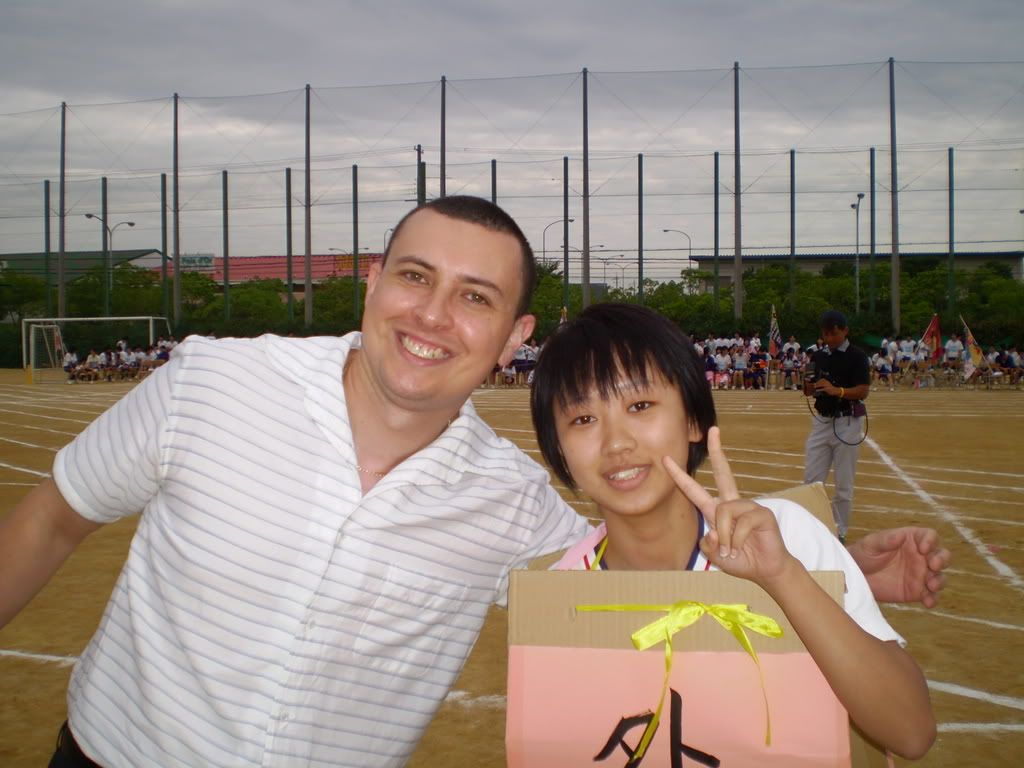
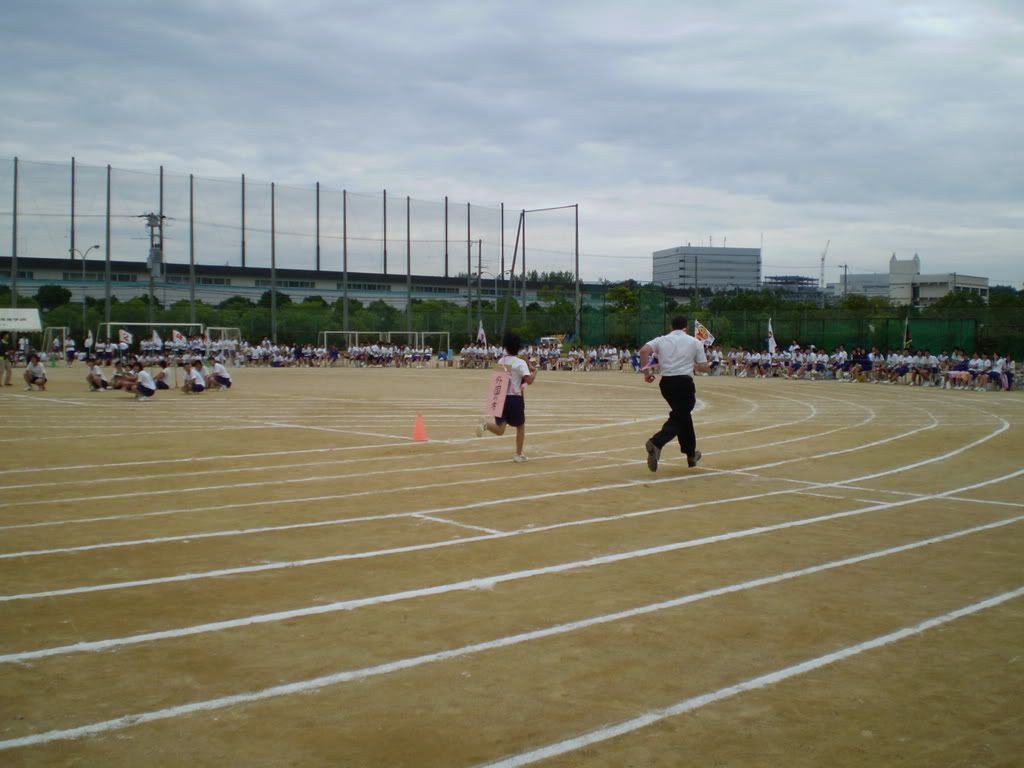
This is a picture of me desperately trying to stave off cardiac arrest, as I run around the oval with my partner. The event in question involves participants racing to either of two tables in the middle of the oval to collect a placard, on which is written a set of instructions, e.g "Find a person wearing glasses." (Or, in my case, "Find a person from a foreign country.") The players then must search the crowd for a person fitting that description, collect him or her, race to another table where both are fitted with a coloured length of ribbon, and then run with their victims around the oval.

Much of the day's events consisted of races and relays: there were no field events, like high jump or long jump, such as one might expect to find at an Australian school sports carnival. But there was half-time entertainment, in the form of traditional Japanese drum music (courtesy of a troupe from the local elementary school), and the school cheerleading squad:


(I'm told those kids are about 5 or 6 years old, on average.)

And there were many lighthearted activities to keep fans and participants entertained, from conventional tug-of-war to a form of tug-of-war-meets-rugby-union involving lengths of bamboo cane.


And I'll never forget the image of 40 students jumping a massive length of rope--an activity in which I had not participated nor seen anyone else participate in since the early of years of primary school (and even then on a much smaller scale).


I don't know how comfortable I'd feel about Australian students whacking each other with sticks a la kendo, but that bamboo cane rugby game is one that definitely needs to be added to the schedule!

Monday, October 1, 2007

Cleaning up the schoolyard


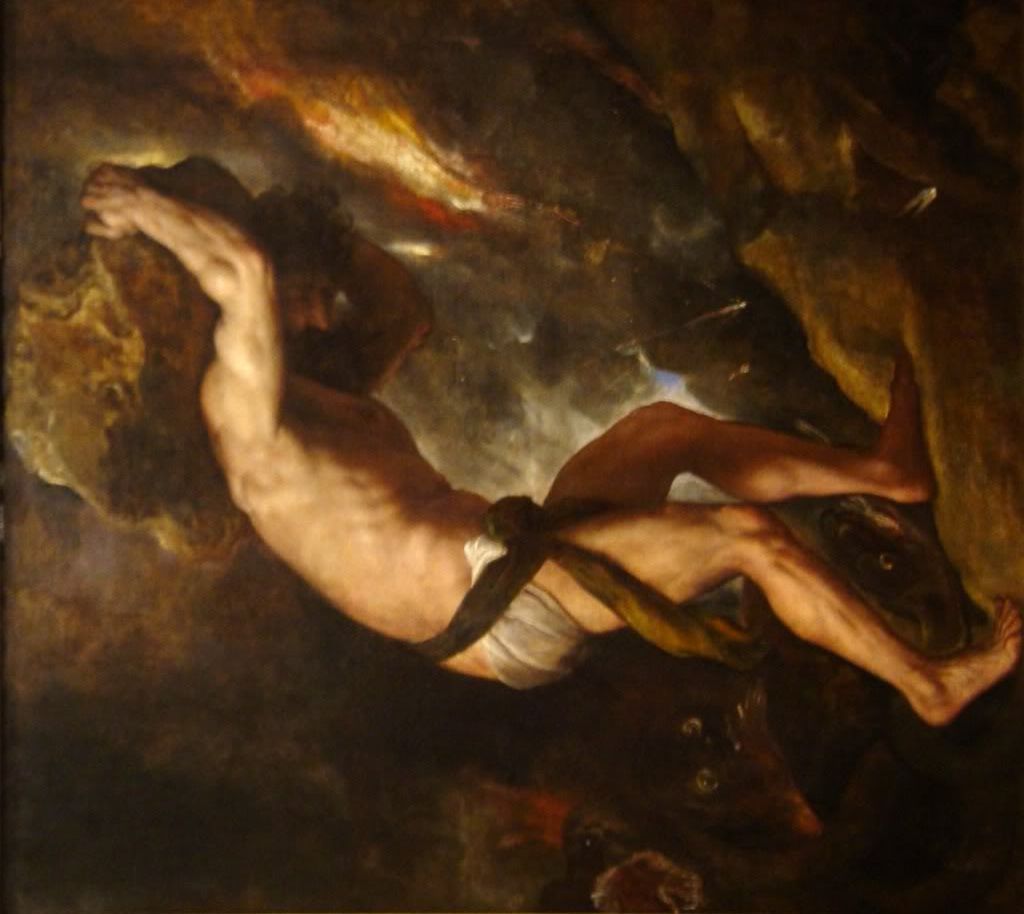
For some reason, spending an afternoon with 60 third-years bearing rakes, forearms and plastic bags, converting little piles of leaves and grass and twigs into big piles of leaves and grass and twigs, put me in mind of the ancient myth of Sisyphus.

And whatever that wriggly, bug-eyed silvery-grey thing was that lurked beneath one of the disgustingly cool and moist little mounds of compost (one which I subsequently avoided), I'm sure it was perfectly safe for droids . . .

Sunday, September 30, 2007

ESL idea #2: Intonation Listening Quiz

(UPDATE: The following is probably going to be of interest only to those few other JETs who stumble across our blog from time to time. I find that the readers of blogs are like domestic cats: if you don't leave a regular supply of Friskies out for them, they'll happily leave and find someone else who will. And faced with the option of blogging about what I had for breakfast or did in the toilet today, and posting an ESL idea that someone, somewhere might actually find useful, I opted for the latter. I promise we'll have more interesting stuff--photos, etc.--soon enough. -- Matt)

Recently I've been teaching intonation in my third-year English conversation classes. I found an online audio quiz which, with some modification and pre-teaching, proved quite effective. The mulitple-choice quiz involves listening to a dialogue between a husband and wife: the wife has some news to break to her husband, and students are required to interpret the emotions/thoughts of the speakers from the intonation they use.

As I mentioned, you will need to pre-teach the concept of intonation as a way of conveying emotions and personal information in English, before you even think about using this quiz in class. Furthermore, the quiz questions as they stand are probably beyond even the average third-year student, so I suggest you make up a worksheet with alternative questions that make the differences between the choices more stark.

I found that this worked most effectively when I split the class into two teams and gave them 5 questions each (there are 10 in total). I also had the benefit of a wonderful JTE who translated the questions into Japanese for me. (I know, I know--that's not strictly vegan kosher, but the point of the exercise is to test student's ability to interpret English intonation, not vocabulary.)

There is a downside: you need a projector, and a computer with a good set of speakers. But if you would like a copy of the lesson plan and worksheets that I used, feel free to email me.

Friday, September 21, 2007

ESL idea #1: Noughts and Crosses


Now that I have taught high school students in two countries, I suspect I may have discovered a universal law of secondary education*. Whether you're in Kobe or in Kallaroo (actually, there's no high school in Kallaroo), if it's the final period of the day on a Friday--especially before a long weekend--the last thing the kids want to do is work. And who can blame them? Work also happens to be last thing teachers want to do at the end of a long week. So you have to improvise if you want to hold their attention for more than ten consecutive seconds.

It doesn't help, of course, that I've decided to introduce them to the rather difficult concept of intonation. They breezed through intonation patterns in questions--i.e. where wh- questions are uttered with a falling intonation, and yes/no questions are uttered with a rising intonation (did you know that?)--but now I'm having to walk them through the use of tone to express feelings, and as I'm having to walk slowly, I end up with a lot of spare time to fill in my lessons. And I hate uncomfortable silences.

Fortunately, I have on my desk a wonderful little book called 96 Games for Beginners in ESL. It belongs to Emma, and she wants it back, but it saved my bacon today. I found a game that is a little like Noughts and Crosses meets The Einstein Factor. The object of the game is pretty straightforward: you have to get a row of three Os or Xs going either across, down, or diagonal. But each square contains a category: past tense, Australia, fruit, spelling, pronunciation, abbreviations, girls' or boys's names, special places and occupations. The class is divided into two teams, and as each team chooses a square it is asked the corresponding question (e.g. "What is the past tense of give?", "What is the capital city of Australia?", "What is the name of a fruit beginning with the letter 'O'?"). If the team cannot answer, the other team is given a chance to answer it and claim the square. As with normal Noughts and Crosses, teams take turns answering questions, until one of the teams has won, or the result is a draw. No materials are required for this task except a whiteboard marker and a whiteboard (my favourite kind of lesson activity), on which is drawn a 3x3 grid.

I discovered today that my students were actually unfamiliar with this game. (Rocks, paper, scissors they are aware of; just not noughts and crosses.) So I quickly drew another 3x3 grid and ran through the rules, before playing a game against them. To give them encouragement, I let them win. They enjoyed the actual games a lot, though one of the last-period-of-the-day teams made a costly strategic error and handed victory to the opposing team on a plate. I'm putting it down to fatigue!


*Logicians please note: this is an example of a hasty generalisation fallacy.

Tuesday, September 18, 2007

Suppose I gave a lesson and nobody came?

I think I just experienced my first "Don't-ask-me-I-just-work-here" moment.

Well, there I was in the Language Lab, all set for today's lesson. The exercises were written on the whiteboard. The worksheets were waiting on the students' desks. The Powerpoint was primed. All that was missing were my students, and the JTE.

Don't panic, I told myself as I collected some of the worksheets that had blown off the desks. Maybe they're just late back from phys. ed. I mean, it's not as if they switched to Monday's timetable because of some soccer thing, out of the clear blue sky, and didn't tell you. That's just crazy-talk.

End of whine.

Tuesday, July 3, 2007

Welcome to our Japan blog

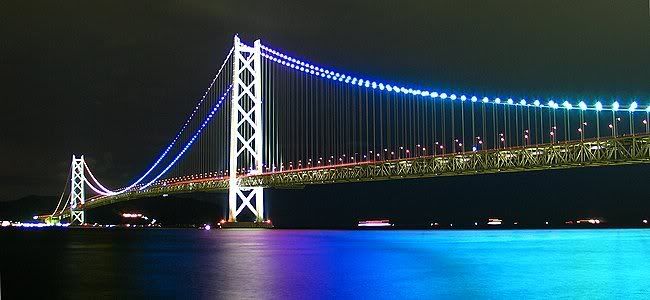
The image above is the Akashi Kaikyo Bridge, which at almost four kilometres in length is the world's longest suspension bridge. And in just over a month's time, this bridge will be one of our local attractions.

You may or may not be aware by now that Matt and I have been placed as JETs in Kobe. The purpose of this blog is for us to keep our friends and family apprised of our adventures in Japan, both in pictures and in words. Though we can't yet be sure what the internet access is like over there, we will try to update it as often as possible.

Feel free to drop us a line!

P.S. The title of the blog is a rather poetic line (well, we think so, anyway) from William Gibson's Neuromancer. Gibson has set many of his novels in Japan--albeit a very futuristic and Western image of Japan (think Blade Runner)--but so far it's the only Japan we know. We are about to get "schooled."