
Emma and I have recently received our postal vote forms, and we've been discussing who we will vote for (and in what order of preference). For those JETs who are reading this, the Australian Embassy in Japan website has information on overseas voting, but you basically have a choice of either pre-poll voting at your nearest Australian consulate, voting at the Embassy or at a selection of consulates on polling day, or postal voting (a form for which is available here).
If you want detailed information on how to vote, your best bet is to consult the relevant pages at the Australian Electoral Commission website:
How to vote for a Member of the House of Representatives
How to vote for a Member of the Senate
But the long and short of it is that at the polling booth (or in the mail, if you're postal-voting), you'll receive a green House of Representatives ballot paper and a white Senate ballot paper. While on the House of Reps paper you must mark all of the boxes in order of preference, the Senate ballot paper is slightly more complicated. There you have the option of either marking all of the boxes below the big black line in order of preference, or placing a "1" in the box next to the party you want to vote for above the line (leaving all other boxes unmarked).
Now, remember: Australia has a preferential voting system, and this includes voting for Members of the Senate. Each party (actually each "group" on the Senate ballot paper: candidates for a particular political party are grouped together, but so also are some independents) lodges with the AEC a full ticket of preferences to all candidates who appear on the ballot paper. It's called a group ticket. Why is this important? Because if you vote above the line, you're consenting to having your preferences allocated according to the group ticket. Apparently more than 95% of voters use this option--this is why you hear of various parties doing "preference deals" and so forth--and I'm betting that relatively few of these are aware of its implications. If you're thinking of voting above the line, I suggest you take a bit of time to look at your state's group voting tickets first.
Anyway, here are the websites of the parties (and independents) that appear on this year's Senate ballot paper:
Nationals
Citizen's Electoral Council
Christian Democratic Party
Non-Custodial Parents Party (Equal Parenting)
Democratic Labor Party
Liberal
Australian Democrats
One Nation WA
Family First
Senator On-Line
Carers Alliance
Australian Labor Party
Eric Wynne (Christian Independent)
Kevin Fitzgerald (Independent)
Climate Change Coalition
Socialist Alliance
Jennifer Armstrong (Secular Party of Australia)
Michael Tan (Secular Party of Australia)
What Women Want (Australia)
Conservatives for Climate and Environment
LDP
The Greens
Richard McNaught (Independent)
Edward Dabrowski (Independent)
Tuesday, November 13, 2007

Friday, November 9, 2007
Oh yeah: the blog header
. . . hasn't worked out as well as we hoped. Anyone familiar with GIMP or Paint.Net and who might be able to suggest how we can get the text to stand out more from the image, we're all ears.
Tuesday, November 6, 2007
October
OK, I have a backlog of three weekends worth of touristy adventures to get through (not including the current weekend), so here goes:
October 13-14: Akashi Planetarium
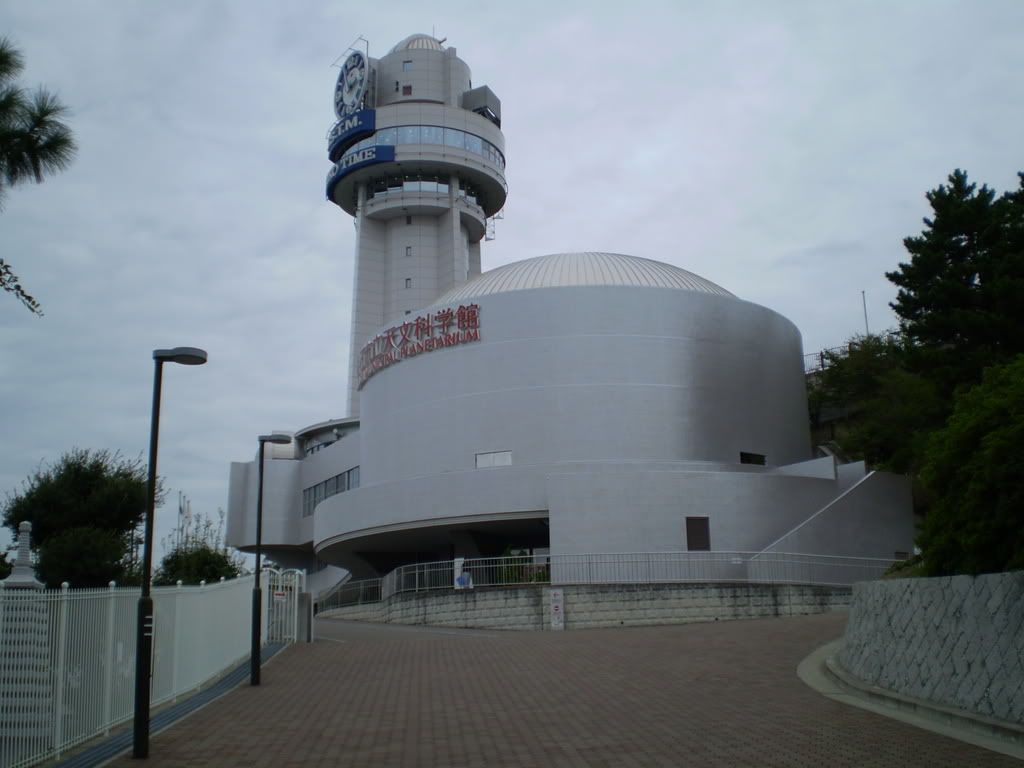 A 3 minute walk north of Hitomarumae Station on the Sanyo line (or 15 minutes east of Akashi station), this is an astronomy education centre housed in a building that looks as though it should be gracing the cover of a 50s science fiction novel. The planetarium features exhibits on the stars and planets, as well as the signs of the Zodiac and the history of timekeeping. Why the history of timekeeping? Because Akashi Planetarium stands exactly at 135 degrees east longitude, and is used to determine Japanese Standard Time. We would have gotten more out of the exhibits if we understood Japanese, but they were interesting nonetheless.
The Imax-style skyshow itself would have been more enlightening if we understood the language, but we followed as best we could. The narrator highlighted and discussed several planets and constellations visible in the northern hemisphere night sky, and at one point played a short cartoon depicting the tale of one of the Greek mythical figures for which many of the constellations are named (I forget which one), underscoring how far human astronomical knowledge has come from the days when the significance of constellations was taken seriously. After a short while I tuned out the drone of the narration, and simply allowed myself to become lost in all those stars and planets. It was very peaceful and relaxing.
The building also sports an observation tower, giving a 360 degree view of this particular corner of Hyogo—including fantastic views of Awaji Island and the bridge. You can take an elevator to the top, or you can act like you’ve got a pair and climb the spiral staircase, tracing the history of life on Earth as you go. Click here for a slideshow.
October 20-21: Sumaura Kooen/Suma Aqualife Park
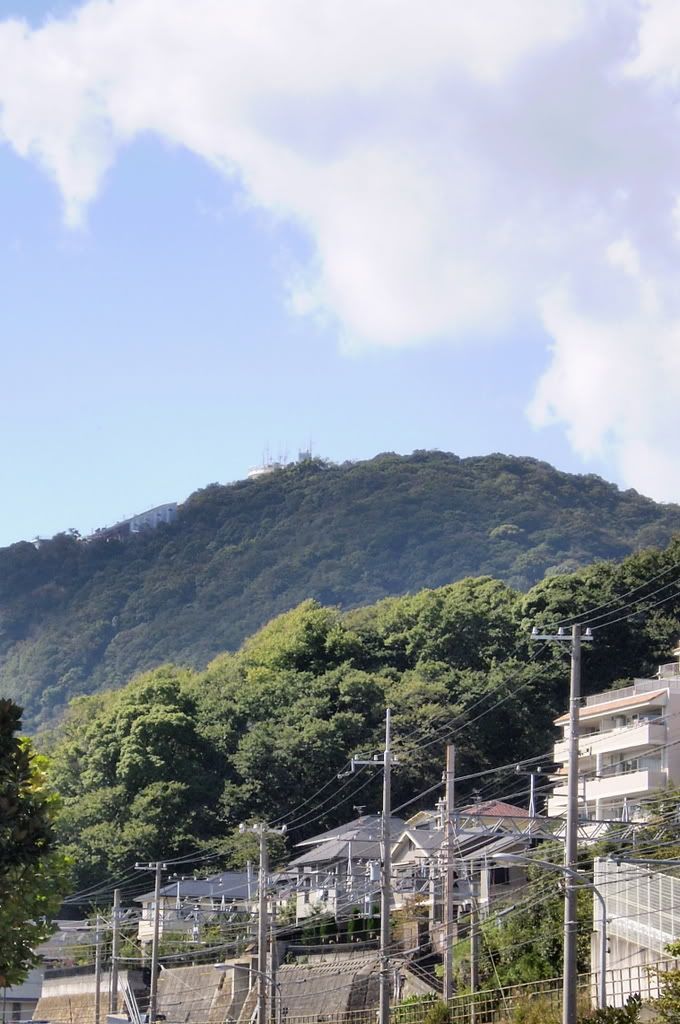 When I first espied Sumaura Kooen on my first day in Kobe, I thought to myself "I'm so climbing that!" The hill (actually called Hachibuse-yama) is an outlier of the Rokko Mountains, and at 248m it dominates the skyline of the adjacent Suma and Tarumi areas. While there is the option of taking a cable-car up to the summit, we opted for one of the thickly-wooded trails that wind their way to the top, having purchased hiking boots in Perth for just this kind of activity. The hill features various ancient shrines and commands amazing views of Kobe city (and beyond) to the east, and the Akashi-Kaikyo Bridge to the west. In Perth I used to spend hours on end wandering the tracks that run through Kings Park; in Sumaura I think I've found a replacement.
How to get there: take the Sanyo line to Sumaura Station. A cheaper option would be to take the JR line to Suma, then walk 15 mins. west.
Slideshows:
Climbing Sumaura
View from the summit
Sumaura area
The following day we returned to Suma to visit its well-known aquarium. (Plus we had coupons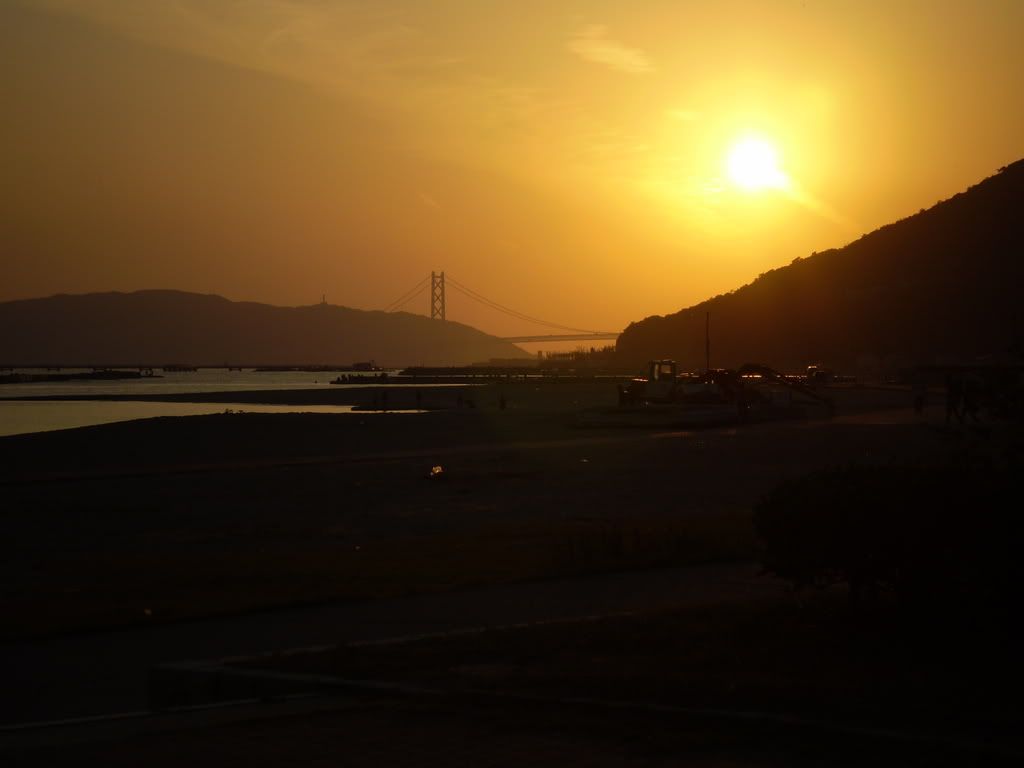 for discount entry.) This was my first visit to an aquarium since I went to Underwater World when I was about eleven or twelve years old. Suma has many advantages over the aforementioned: it is far more reasonably-priced, its giant fish/shark/ray tank makes for one breathtaking entrance-statement, and nobody has yet slipped Suma's dolphins any happy pills, so you can still see them performing regularly. The tropical fish are amazing, and thanks to Emma's nifty camerawork (and image manipulation work) we've hopefully managed to capture that for you.
How to get there: From JR Suma Station, walk 15 mins east. In warmer months I suggest walking there along Suma Beach, which is apparently a very popular spot with the citizens of Kobe and is highly reminiscent of the beach in William Shakespeare’s Romeo and Juliet (albeit minus Harold Perrineau firing pistols into the water for no apparent reason whatsoever). Take the beach route back to the station as well if you're returning in the late afternoon: it's worth it to see the sun setting over the shoulder of Hachibuse-yama. Click here for slideshow.
October 27-28: Oji Zoo
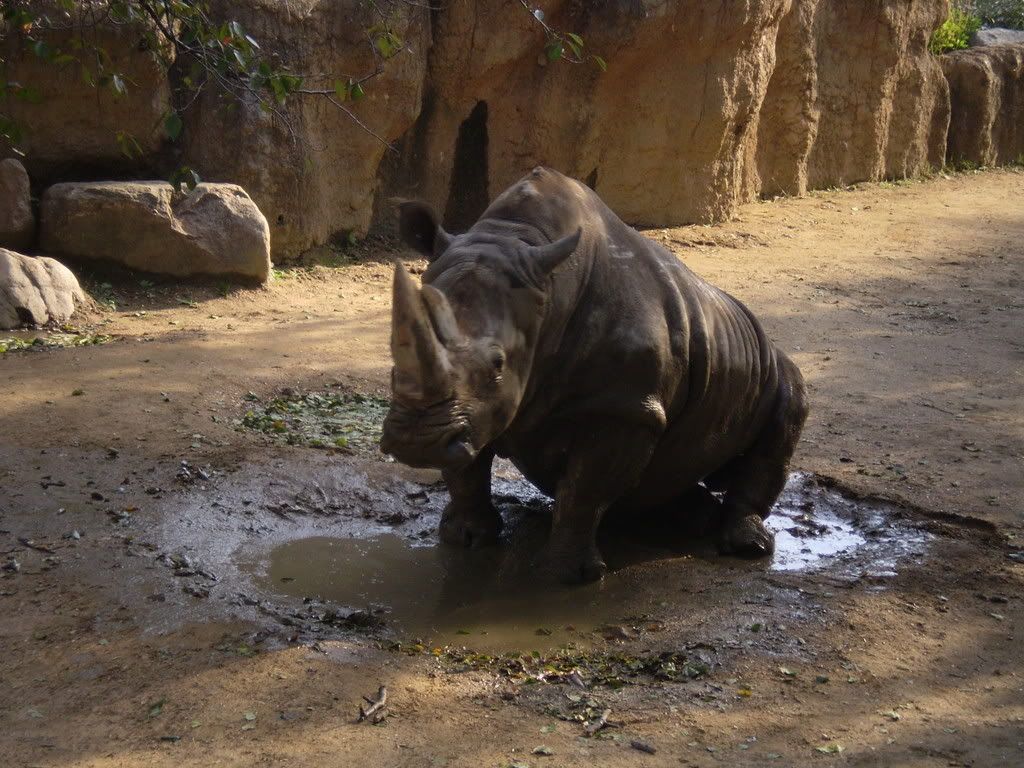 I learned something new this weekend. In fact: I learned three new things. First, while pink flamingos might be charming in a kitschy kind of way as lawn ornaments, a pen of live birds has to be one the foulest smelling things on Earth. Second, I was wrong about the first point: the foulest smelling thing on Earth has to be Japanese brown bear urine. Third, Amazonian pythons doubtless seem intimidating when encountered in the wild, but when you coop them up in a glass cage, they just look really, really bored.
Come to think of it: the same could be said for most of the animals we saw that day. That could explain why the European timberwolf, which is really just a dog in the “state of nature,” was playfully following children from window to window. On the other hand, it might have been hungry.
Click here for the slideshow.
Oji Zoo is about a 10 minute walk north of Nada Station on the JR line.
October 13-14: Akashi Planetarium
A 3 minute walk north of Hitomarumae Station on the Sanyo line (or 15 minutes east of Akashi station), this is an astronomy education centre housed in a building that looks as though it should be gracing the cover of a 50s science fiction novel. The planetarium features exhibits on the stars and planets, as well as the signs of the Zodiac and the history of timekeeping. Why the history of timekeeping? Because Akashi Planetarium stands exactly at 135 degrees east longitude, and is used to determine Japanese Standard Time. We would have gotten more out of the exhibits if we understood Japanese, but they were interesting nonetheless.The Imax-style skyshow itself would have been more enlightening if we understood the language, but we followed as best we could. The narrator highlighted and discussed several planets and constellations visible in the northern hemisphere night sky, and at one point played a short cartoon depicting the tale of one of the Greek mythical figures for which many of the constellations are named (I forget which one), underscoring how far human astronomical knowledge has come from the days when the significance of constellations was taken seriously. After a short while I tuned out the drone of the narration, and simply allowed myself to become lost in all those stars and planets. It was very peaceful and relaxing.
The building also sports an observation tower, giving a 360 degree view of this particular corner of Hyogo—including fantastic views of Awaji Island and the bridge. You can take an elevator to the top, or you can act like you’ve got a pair and climb the spiral staircase, tracing the history of life on Earth as you go. Click here for a slideshow.
October 20-21: Sumaura Kooen/Suma Aqualife Park
When I first espied Sumaura Kooen on my first day in Kobe, I thought to myself "I'm so climbing that!" The hill (actually called Hachibuse-yama) is an outlier of the Rokko Mountains, and at 248m it dominates the skyline of the adjacent Suma and Tarumi areas. While there is the option of taking a cable-car up to the summit, we opted for one of the thickly-wooded trails that wind their way to the top, having purchased hiking boots in Perth for just this kind of activity. The hill features various ancient shrines and commands amazing views of Kobe city (and beyond) to the east, and the Akashi-Kaikyo Bridge to the west. In Perth I used to spend hours on end wandering the tracks that run through Kings Park; in Sumaura I think I've found a replacement.How to get there: take the Sanyo line to Sumaura Station. A cheaper option would be to take the JR line to Suma, then walk 15 mins. west.
Slideshows:
Climbing Sumaura
View from the summit
Sumaura area
The following day we returned to Suma to visit its well-known aquarium. (Plus we had coupons
for discount entry.) This was my first visit to an aquarium since I went to Underwater World when I was about eleven or twelve years old. Suma has many advantages over the aforementioned: it is far more reasonably-priced, its giant fish/shark/ray tank makes for one breathtaking entrance-statement, and nobody has yet slipped Suma's dolphins any happy pills, so you can still see them performing regularly. The tropical fish are amazing, and thanks to Emma's nifty camerawork (and image manipulation work) we've hopefully managed to capture that for you.How to get there: From JR Suma Station, walk 15 mins east. In warmer months I suggest walking there along Suma Beach, which is apparently a very popular spot with the citizens of Kobe and is highly reminiscent of the beach in William Shakespeare’s Romeo and Juliet (albeit minus Harold Perrineau firing pistols into the water for no apparent reason whatsoever). Take the beach route back to the station as well if you're returning in the late afternoon: it's worth it to see the sun setting over the shoulder of Hachibuse-yama. Click here for slideshow.
October 27-28: Oji Zoo
I learned something new this weekend. In fact: I learned three new things. First, while pink flamingos might be charming in a kitschy kind of way as lawn ornaments, a pen of live birds has to be one the foulest smelling things on Earth. Second, I was wrong about the first point: the foulest smelling thing on Earth has to be Japanese brown bear urine. Third, Amazonian pythons doubtless seem intimidating when encountered in the wild, but when you coop them up in a glass cage, they just look really, really bored.Come to think of it: the same could be said for most of the animals we saw that day. That could explain why the European timberwolf, which is really just a dog in the “state of nature,” was playfully following children from window to window. On the other hand, it might have been hungry.
Click here for the slideshow.
Oji Zoo is about a 10 minute walk north of Nada Station on the JR line.
Wednesday, October 31, 2007
Things you don't expect to happen in Japan . . .
. . . such as the Jehovah's Witnesses knocking at your door. Or in our case, peeking in through the open door while we were putting away the groceries on a Tuesday night.
In a country that is not only overwhelmingly Buddhist and Shinto, but in which a syncretic approach to religious observance predominates, the experience of having the JWs tap on your door as they would in Australia is a tad disorienting, to be frank. Had this been Australia, I would have relished the opportunity to engage these people--I am not as reluctant nowadays to debate the Saturday morning religious callers as I once might have been, for reasons which you'll have to ask me in private. On this occasion, given that our visitors were Japanese, I settled for as polite a "No thankyou, I'm not interested" as I could manage. I hope I didn't seem too rude.
There are apparently more than 200, 000 JWs in Japan. Suppressed by Imperial Japan in the interwar period, proselytism by American missionaries in the 60s led to a rapid growth in Japanese converts over the last three decades of the 20th century. (Growth has fallen off significantly since then.) The country was visited by the founder of the sect, Charles Taze Russell, in 1911, on a world tour to convert the "heathens." He described the prevailing Japanese attitude towards religion as "toward infidelity, doubt and atheism." My kind of place. :)
In a country that is not only overwhelmingly Buddhist and Shinto, but in which a syncretic approach to religious observance predominates, the experience of having the JWs tap on your door as they would in Australia is a tad disorienting, to be frank. Had this been Australia, I would have relished the opportunity to engage these people--I am not as reluctant nowadays to debate the Saturday morning religious callers as I once might have been, for reasons which you'll have to ask me in private. On this occasion, given that our visitors were Japanese, I settled for as polite a "No thankyou, I'm not interested" as I could manage. I hope I didn't seem too rude.
There are apparently more than 200, 000 JWs in Japan. Suppressed by Imperial Japan in the interwar period, proselytism by American missionaries in the 60s led to a rapid growth in Japanese converts over the last three decades of the 20th century. (Growth has fallen off significantly since then.) The country was visited by the founder of the sect, Charles Taze Russell, in 1911, on a world tour to convert the "heathens." He described the prevailing Japanese attitude towards religion as "toward infidelity, doubt and atheism." My kind of place. :)
Friday, October 26, 2007
Watching An Inconvenient Truth in Japanese
Last Wednesday I joined the first-years in the gymnasium for a screening of An Inconvenient Truth. Since I'd already seen the film last year, I didn't mind that it had been dubbed into Japanese. Plus, such is Gore's dexterity with Keynote (Apple's version of PowerPoint)--not to mention that crane he uses--that his presentation would be easy to follow in any language.
I found it compelling (and polls indicate that about 70% of Japanese are concerned about global warming); but I did notice a few students seizing the opportunity of a darkened room to catch up on some shut-eye. They usually have to wait for my classes in order to do that!
P.S. On the subject of global warming, here's a YouTube that has been doing the rounds:
I found it compelling (and polls indicate that about 70% of Japanese are concerned about global warming); but I did notice a few students seizing the opportunity of a darkened room to catch up on some shut-eye. They usually have to wait for my classes in order to do that!
P.S. On the subject of global warming, here's a YouTube that has been doing the rounds:
Sunday, October 14, 2007
Last weekend's journey to Minas Tirith and Rivendell . . .
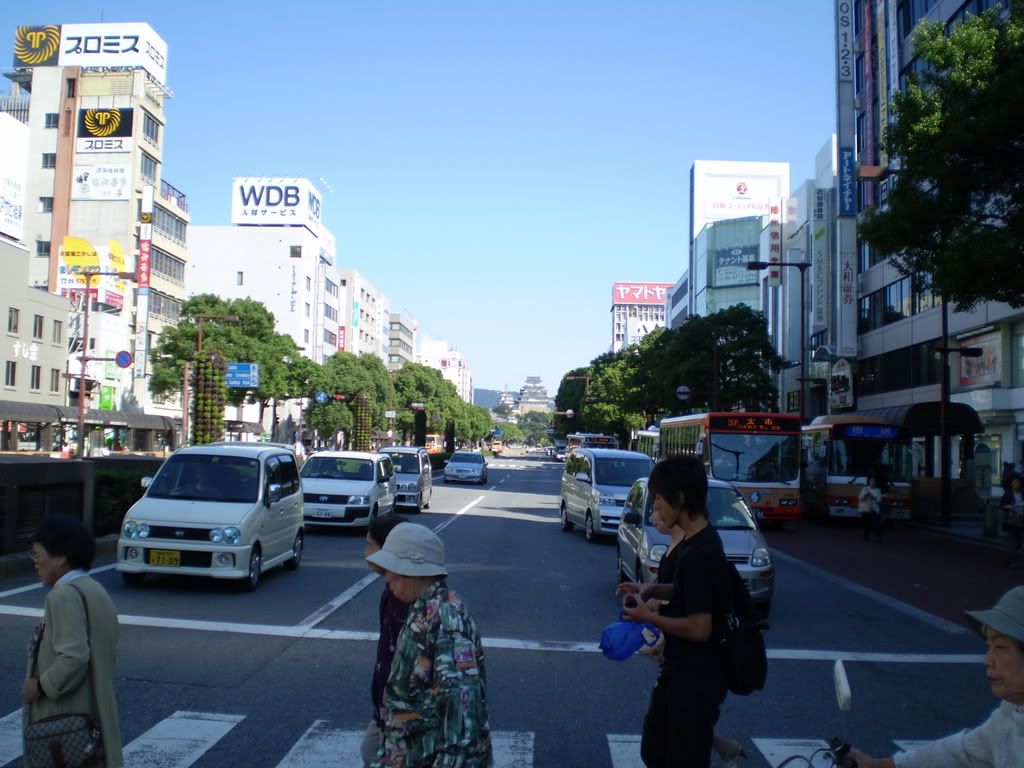 . . . a.k.a. Himeji Castle and Kokoen.
Last Saturday Emma and I took a train to Himeji to see its famous castle--the first castle I had ever visited since Kryal Castle in 1988. (Kryal Castle is Australia's most well-known medieval castle--which is interesting, since Australia was only first settled by Europeans in the eighteenth century.) I won't say too much about it--I'll let Photobucket and Wikipedia do most of the talking--other than to remark that one of the first things you notice as you emerge from the train station and gaze down what has to be one of the widest streets in Japan (one of the JTEs at my school informs me that said street was purpose-built for a visit by the Emperor soon after the Second World War), is that--despite the fact that Himeji is a city of half a million people and is abundant in tall buildings--the eponymous castle really dominates the landscape.
The other thing you notice is that Himeji itself is roomy--big in the way an Australian city or large town is roomy--which is most unlike the Japan we had hitherto experienced. (Well, certainly unlike Tarumi; though I suppose Seishin-chuo, the Joondalup-esque area of Kobe where I work, is roomy in its own way.) Japan is one of the world's most populous nations, and all of those people have to squeeze onto a set of very small islands--so often you find yourself on very narrow streets, hemmed in by towers and tenements. Central Himeji just doesn't feel like that.
Anyway, here a couple of Himeji Castle slideshows. (I apologise if they slow down your browser.)
And here is Nishi-Oyashiki-ato Kokoen. It is adjacent to Himeji Castle, and used to be the residence of a samurai lord, apparently. Now it comprises a series of serene and beautiful gardens (let's just say Jamie Durie and Scott Cam couldn't hold a scented candle), along with a teahouse. (They don't do Devonshire, alas, but the lady at the desk is very helpful and speaks excellent English.)
We also visited Himeji's art gallery, having bumped into Daniel Carter at a park along the way. (Where the three of us discovered that not only are some dogs just as skilled at frisbee as humans, they are also permitted to drink from our water fountains. Now, that's just wrong.) The gallery featured an exhibition on Surrealism to which we arts graduates--true to form--couldn't say no. ALTs: if the exhibition reaches an art gallery near you, it's well worth the admission.


Sunday, October 7, 2007
School sports day
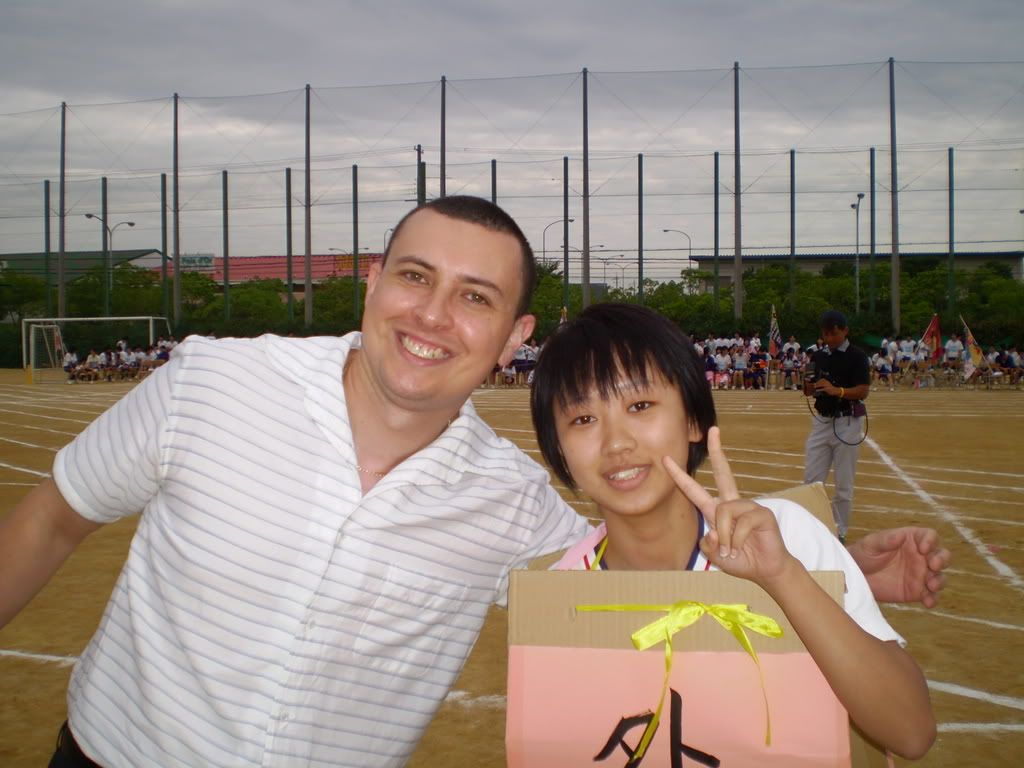 Being averse to most forms of physical activity in my school days, I always hated school sports carnivals. (Well: except for the Year 8 carnival, where I won first, second, and third place ribbons in the 100, 200 and 400m. I was in 'C' division--one or two divisions above wheelchairs and zimmer frames.) I always considered school sports as a form of psychological torture designed to shatter the self-esteem of those students who, like myself, lacked the agility and hand-eye co-ordination of our peers (some of the latter who had few qualms about pointing these failings out to us in no uncertain terms), causing them to seek solace in eating disorders, heavy metal music, fantasy role-playing games and so forth. (Maybe that's how the whole 'emo' trend got started; I don't know.)
But I have to take my hat off to Japanese students, who to a girl and boy participate in their school carnivals with far more gusto than I could ever manage, and (to a foreigner's eye, at least) with far less self-consciousness. Apparently, school sports days in Japan originated in the Meiji period, during which Japan emerged from isolationism and endeavoured to become a world power on a par with Western countries like the UK and the US. The Victorian preoccupation with health and fitness was mirrored by the Japanese education minister's decree that sports days be held in all schools "in order to improve the physical abilities of Japanese people, who were seen as poor at sports compared to Westerners." In any event, the Japanese continue to take their sports carnivals very seriously.
Case in point: they have Olympic-style opening ceremonies, complete with competing factions marching into the arena behind their own banners, the raising of the school and national flags, and the school band in full song. Oh, and I almost forgot . . .
The definitive you-know-you're-in-Japan-when moment: the principal leading the entire school in an aerobics session. All they are missing are the business suits.
For much of the day I kept myself occupied honing my skills as a sports photographer, but as you can see . . .
. . . there's only so much a $250 digital camera can do. But I did get involved in other ways.
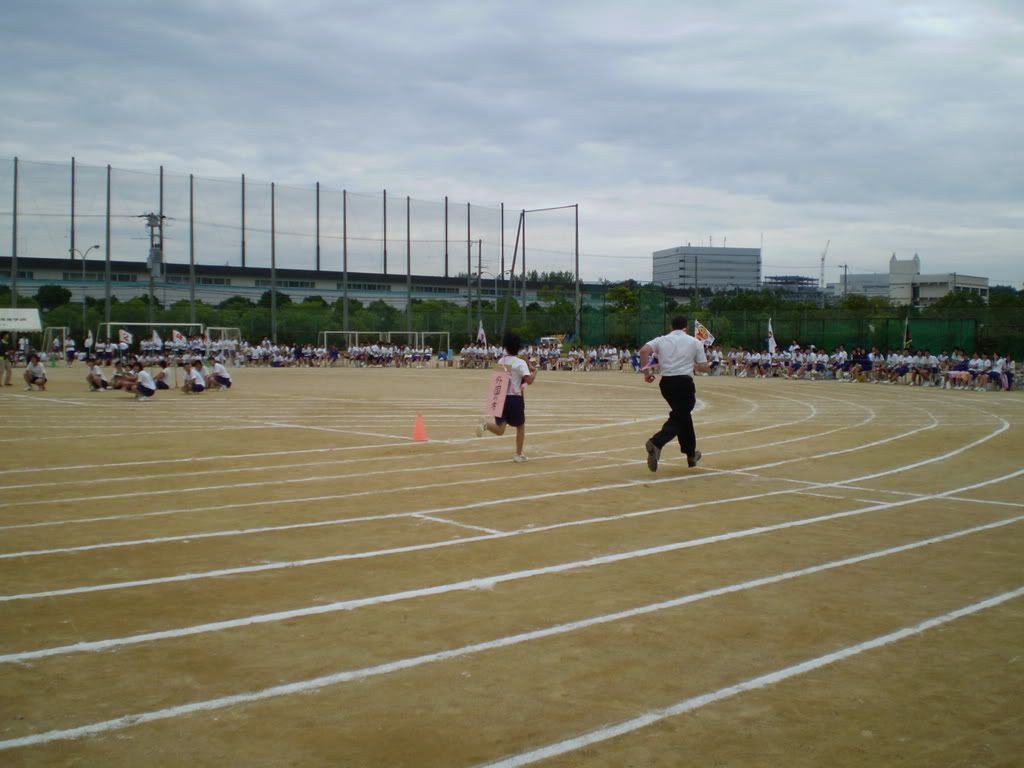 This is a picture of me desperately trying to stave off cardiac arrest, as I run around the oval with my partner. The event in question involves participants racing to either of two tables in the middle of the oval to collect a placard, on which is written a set of instructions, e.g "Find a person wearing glasses." (Or, in my case, "Find a person from a foreign country.") The players then must search the crowd for a person fitting that description, collect him or her, race to another table where both are fitted with a coloured length of ribbon, and then run with their victims around the oval.
Much of the day's events consisted of races and relays: there were no field events, like high jump or long jump, such as one might expect to find at an Australian school sports carnival. But there was half-time entertainment, in the form of traditional Japanese drum music (courtesy of a troupe from the local elementary school), and the school cheerleading squad:
(I'm told those kids are about 5 or 6 years old, on average.)
And there were many lighthearted activities to keep fans and participants entertained, from conventional tug-of-war to a form of tug-of-war-meets-rugby-union involving lengths of bamboo cane.
And I'll never forget the image of 40 students jumping a massive length of rope--an activity in which I had not participated nor seen anyone else participate in since the early of years of primary school (and even then on a much smaller scale).
I don't know how comfortable I'd feel about Australian students whacking each other with sticks a la kendo, but that bamboo cane rugby game is one that definitely needs to be added to the schedule!
Subscribe to:
Posts (Atom)